- THE NEXT THING NOW
- Posts
- Less grunt work and living computers

Day to day you are already seeing that AI is ripping through old ways of working (or at least promising too). Maybe your copilot rollout is under performing by your developers are dropping grunt work and teams are reshaping how they deliver. What once slowed projects down is now automated in seconds.
That’s happing right now.. in the real world…
Meanwhile, scientists are wiring living brain cells into computers. It sounds like science fiction but research in this space is moving at pace.
One shift is already changing your business. The other could redefine what computing even is.
Both point to the same challenge. How do leaders stay in control when the rules of software are being rewritten?
AI Enablement
Every technology leader knows the frustration of seeing teams burn time on tasks that add little value. Regression testing, scaffolding, bug triage, documentation. You know the list.
AI is stripping that work out of the day-to-day. A developer can now spin up a test harness while making coffee. Documentation writes itself while workshops are still in session. Even legacy codebases, once a maze for new joiners, can be navigated in days instead of months.
The effect is not just efficiency. It is a cultural shift. Engineers spend more of their energy on architecture and problem solving, and less on chores. This results in teams members feeling lighter, more creative, and more productive.
This shift also changes the shape of organisations. The old pyramid model, with layers of developers at the base, is giving way to a diamond. A stronger middle of architectural thinkers, supported by AI tooling that amplifies output beneath and above.
For CIOs, that means the most valuable skills are evolving. Coding remains important, but orchestration, architectural design, and coaching are rising to the surface. These are the roles that unlock AI’s potential and keep delivery moving at speed.
Wetware Computing
Bare with me…. I think this is fascinating.
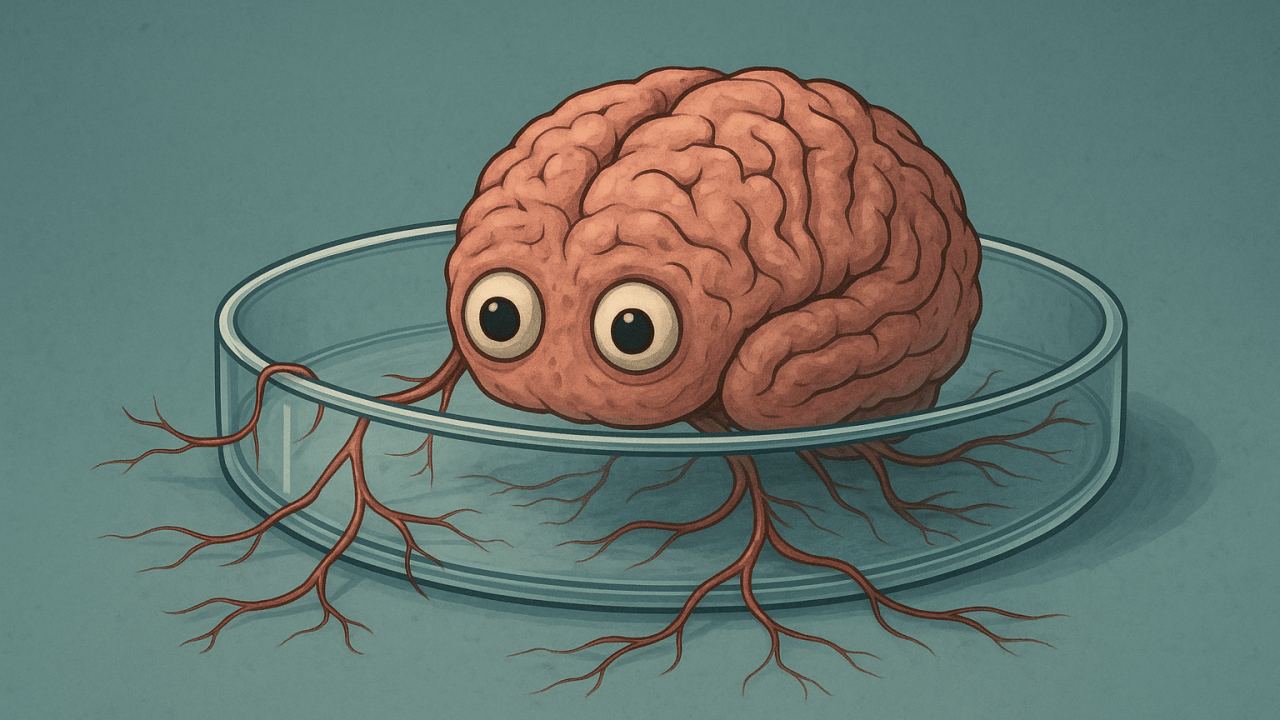
In research labs around the world, scientists are experimenting with a new kind of processor. Not silicon. Living brain cells.
These clusters of neurons, known as organoids, can fire, synchronise, and even adapt to stimuli. Early prototypes are showing they can learn in simple ways and do it with an energy efficiency silicon cannot touch. The human brain runs on less power than a dim lightbulb, yet outperforms the largest AI models in adaptability and learning. The plan is to harness that.
The potential is intriguing. Imagine hybrid systems that use silicon for raw speed, but living neurons for memory and adaptability. Imagine devices that can learn continuously without retraining. Imagine energy use so efficient that edge devices could run with minimal power draw.
For now, ‘wetware’ computing is more an experiment than enterprise solution. But it serves as a reminder that the definition of “computer” is not fixed. It is evolving, sometimes in ways that feel uncomfortable.
Obviously ‘wetware’ computing is still a long way from the boardroom. Think more science fiction than product roadmap. But it is worth paying attention. History has a habit of moving experimental tech into mainstream use faster than expected and it’s another sign that the pace of change is picking up in an exciting way.
If you want to dig a little deeper Dootrix CTO Kevin Smith nerded out on this over on LinkedIn.
👉 When Flesh Becomes Compute: What Brain Organoids Might Mean for AI
THE NEXT THING NOW PODCAST
In the latest episode of The Next Thing Now, we dug into one of the first real-world uses of the Model Context Protocol. Claude can now control Canva directly through natural language. No buttons. No interface. Just intent, expressed in words.
It is an early glimpse of how agents will slip into everyday workflows. Tools talking to tools. Interfaces that disappear into conversation.
We also broke down the Windsurf saga; a $3B deal collapsing, Google and Devin scooping up the pieces, and the sense that agentic coding tools are heading into their own dot-com moment.
This eposiode shows more evidence that Agentic Software is here. Agents are in production. The question for leaders is not if they will matter, but how to prepare for the scale and speed of their adoption.

Further Reading
Centaur: AI that models human cognition
A Nature paper introducing a model fine-tuned on psychology datasets to simulate human decision-making. A step toward systems that think more like people, not just process language.
Read on NatureFinalSpark’s wetware experiments
A Swiss startup exploring processors built from living neurons. Their GitHub offers a window into biocomputing research that sits at the intersection of biology and AI.
Explore FinalSpark on GitHubBruce Schneier on AI memory and profiling
A sharp take on how LLMs build user dossiers, what they store, and what that means for trust. Raises questions every leader should be asking about transparency in AI systems.
Read on Schneier’s blogContinuous AI in software workflows
GitHub Next’s project exploring how AI can act like CI/CD for collaboration. Automation not just for code, but for communication and documentation.
View the project
Until next time….